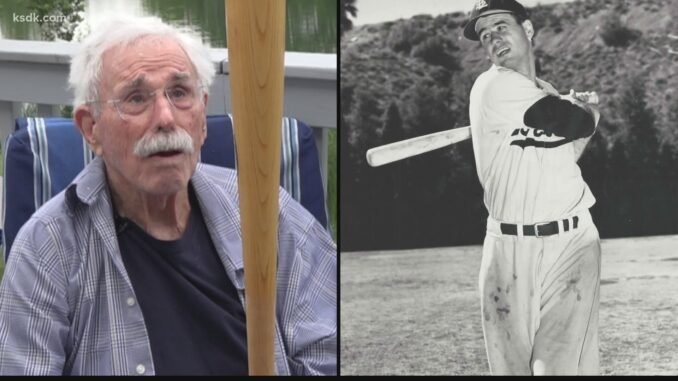
A Second Wave of Grief in Baseball: Remembering Ed Mickelson
The professional baseball world is once again enveloped in sorrow following the passing of Edward Allen Ed Mickelson—a player with a brief, but memorable impact on the sport. Mickelson, who passed away on June 27, 2025, at the age of 98, had a playing career that spanned 11 professional seasons. Despite only seeing limited Major League action—totaling just 18 games—his legacy carries profound historical weight, particularly in St. Louis.
Born in Ottawa, Illinois on September 9, 1926, Mickelson began his path to baseball at Washington University in St. Louis and later at Oklahoma State University. He signed his first professional contract with the St. Louis Cardinals in 1947 following a minor league season in which he batted a remarkable .413 across two Class B leagues. His .400-level performance earned him a late-season call-up to the big leagues.
Mickelson made his MLB debut on September 18, 1950, but saw very little game time—only five games and 12 plate appearances with the Cardinals, managing just a single hit. With stalwarts like Stan Musial firmly entrenched at the same position, opportunities were scarce.
Three years later, in 1953, Mickelson resurfaced with the St. Louis Browns—a franchise that would soon relocate and become the Baltimore Orioles—and made history. During the Browns’ final game in St. Louis on September 27, he hit a single that produced the team’s last-ever run before its move. Facing the Chicago White Sox, he drove in Johnny Groth in the third inning to give the Browns a 1–0 lead. Though the game ultimately went into extra innings, the hit remains a landmark moment: the Browns never scored in St. Louis again and became the Orioles that winter.
This singular hit would be Mickelson’s final one in the majors. After that game, the Browns moved, and although he briefly joined the Chicago Cubs in 1957 for six games, he finished hitless in 12 at‑bats, ending his Major League stats at a lowly .081 batting average, zero home runs, and just three RBIs.
But beneath that modest major-league veneer was a dominant minor league career. Over 11 seasons, he racked up 1,374 hits and posted a .316 average—numbers reflecting immense success in the minor circuit, though never fully realized in the majors.

Mickelson wasn’t just a ballplayer—his life off the field was rich and deeply human. Born in Illinois, he was a multi-sport standout in high school and collegiate athletics. He even served in the U.S. Army Air Corps during World War II. A gifted athlete, he was once offered a basketball scholarship at the University of Tennessee but ultimately continued his college career closer to home in Missouri.
In the minors, he faced legends—notably striking out Mickey Mantle and observing the legendary Satchel Paige warming up with matchbox precision on the mound. He also experienced first-hand the challenges many athletes face after the spotlight fades. The transition from the field to life afterward wasn’t easy: Mickelson once battled profound depression and even contemplated suicide, but eventually sought treatment, overcoming his darkest days to become a counselor and mentor for high schools in St. Louis.
He was also a writer and memoirist. In 2007, he published A Memoir of a Minor League Baseball All‑Star, offering candid insight into the grind of the minors, his wartime service, injuries, and the loneliness of professional sports.
At the time of his death, only three former St. Louis Browns were still living, Mickelson being one of them alongside Frank Saucier (also age 98) and Billy Hunter (96). His passing makes Hunter the final survivor from the Browns era.
Survived by his wife Mary, two children (Eric and Julie), eight grandchildren, and twelve great-grandchildren, Mickelson leaves behind a legacy that transcends his on-field statistics. Through his memoir, family, and mental health advocacy, his impact resonates far beyond the baseball diamond.
In sum, Ed Mickelson’s life story is one of tenacity, quiet achievement, historical stamp, and human resilience. His name may not stand tall in the annals of baseball stat sheets, but his single RBI in 1953 ensures his permanent place in the rich tapestry of St. Louis baseball history. And perhaps most enduring is his journey from wartime service to the sports arena, through despair, to a place of hope, mentorship, and profound personal growth—a legacy that will reverberate within the game and beyond for generations to come.
Leave a Reply