
The New York Mets’ rotation took a major blow on Friday with the announcement that right-hander Griffin Canning will miss the remainder of the season due to a ruptured left Achilles tendon.
Manager Carlos Mendoza confirmed the injury and revealed that Canning has already undergone surgery. The 29-year-old had emerged as a valuable asset for the Mets after signing a one-year, $4.25 million deal in December. In 16 starts, Canning posted a 7-3 record with a 3.77 ERA—an impressive turnaround from his rough 2024 campaign with the Los Angeles Angels.
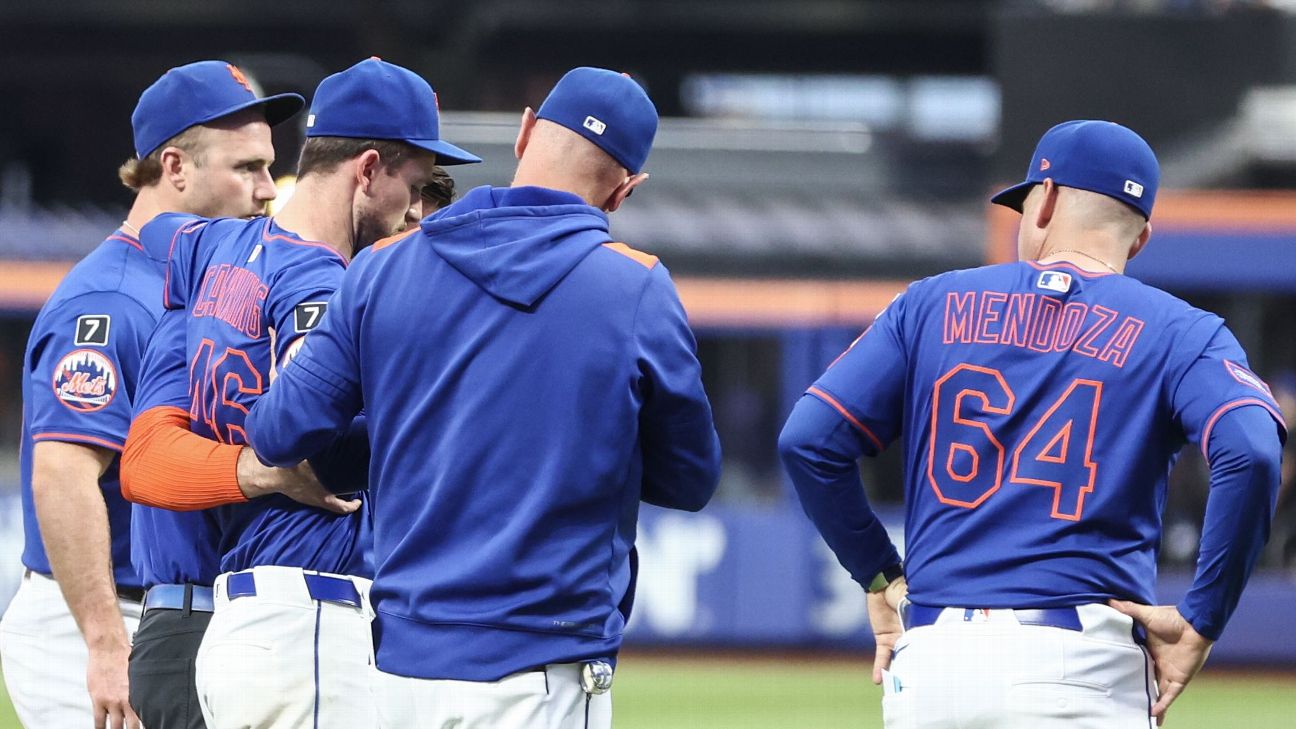
The injury occurred during the third inning of Thursday’s 4–0 win over the Atlanta Braves. While backing up third base on a routine ground ball, Canning planted his left leg and collapsed in pain. Catcher Luis Torrens quickly signaled for medical attention, and Canning had to be helped off the field after several minutes on the ground.
“You hate to see it, especially the way he went down,” Mendoza said, per The Athletic’s Will Sammon. “You feel for the guy.”
Canning’s loss leaves the Mets scrambling once again to patch together a rotation that has been riddled with injuries throughout the season. His strong performance had provided much-needed stability, making this setback all the more painful for a team trying to stay afloat in the playoff race.
How Does Griffin Canning’s Injury Affect Mets?
Griffin Canning’s season-ending Achilles injury is just the latest blow to a New York Mets rotation already reeling from attrition. He becomes the third starter to hit the injured list this month, joining Kodai Senga (strained hamstring) and Tylor Megill (elbow strain). The timing couldn’t be worse, as the Mets attempt to maintain their narrow lead in a tight NL East race.
Despite boasting MLB’s best team ERA at 3.21, New York has stumbled recently, dropping seven of their last ten games and briefly relinquishing first place in the division before reclaiming a slim half-game edge entering Friday’s opener against the Pittsburgh Pirates.
With Canning now out, the Mets are relying on a patched-together rotation of David Peterson, Clay Holmes, Paul Blackburn, Frankie Montas, and rookie Blade Tidwell, who was recalled Friday from Triple-A Syracuse as part of a flurry of roster moves. It’s a group long on potential but short on reliability, particularly with the division-rival Phillies charging hard.
Meanwhile, left-hander Sean Manaea—who hasn’t pitched in the majors yet this season due to an oblique strain—may finally be nearing his return. However, a recent diagnosis of a bone chip in his elbow following a Triple-A rehab outing adds uncertainty to his timeline, according to MLB.com’s Anthony DiComo.
Canning’s injury not only removes one of the Mets’ most effective and unexpected contributors but also puts immense pressure on the club’s remaining arms. With the All-Star break approaching and the trade deadline looming, New York’s front office may soon be forced to decide whether to stand pat or make an aggressive move to reinforce a rotation that’s quickly running out of options.
Griffin Canning Had Become Trusted Part of Mets Rotation
Griffin Canning’s 2025 season was shaping up to be a redemption story—until a devastating Achilles injury abruptly ended it. After struggling in 2024 with the Angels, where he posted a 6–13 record and a 5.19 ERA over 32 appearances (31 starts), Canning joined the Mets as a depth option on a one-year, $4.25 million deal. But when Sean Manaea went down in spring, Canning stepped into the rotation—and thrived.
Despite recent bumps in the road, with a 4.09 ERA in May and 5.01 in June, Canning had emerged as one of the Mets’ most reliable arms and was outperforming expectations. His 7–3 record and 3.77 ERA over 16 starts had him trending toward a promising free-agent payday this offseason.
After undergoing surgery for his torn Achilles, Canning shared a message on social media platform X (formerly Twitter):
“Unfortunate way to end my season but looking forward to the challenge of getting back better and stronger. Appreciate everyone reaching out.”
Canning’s journey back will now be focused on recovery and rehabilitation, with hopes of returning to form in 2026. His absence, however, creates another void for a Mets team clinging to the top of the NL East and already stretched thin in its starting rotation.
Leave a Reply